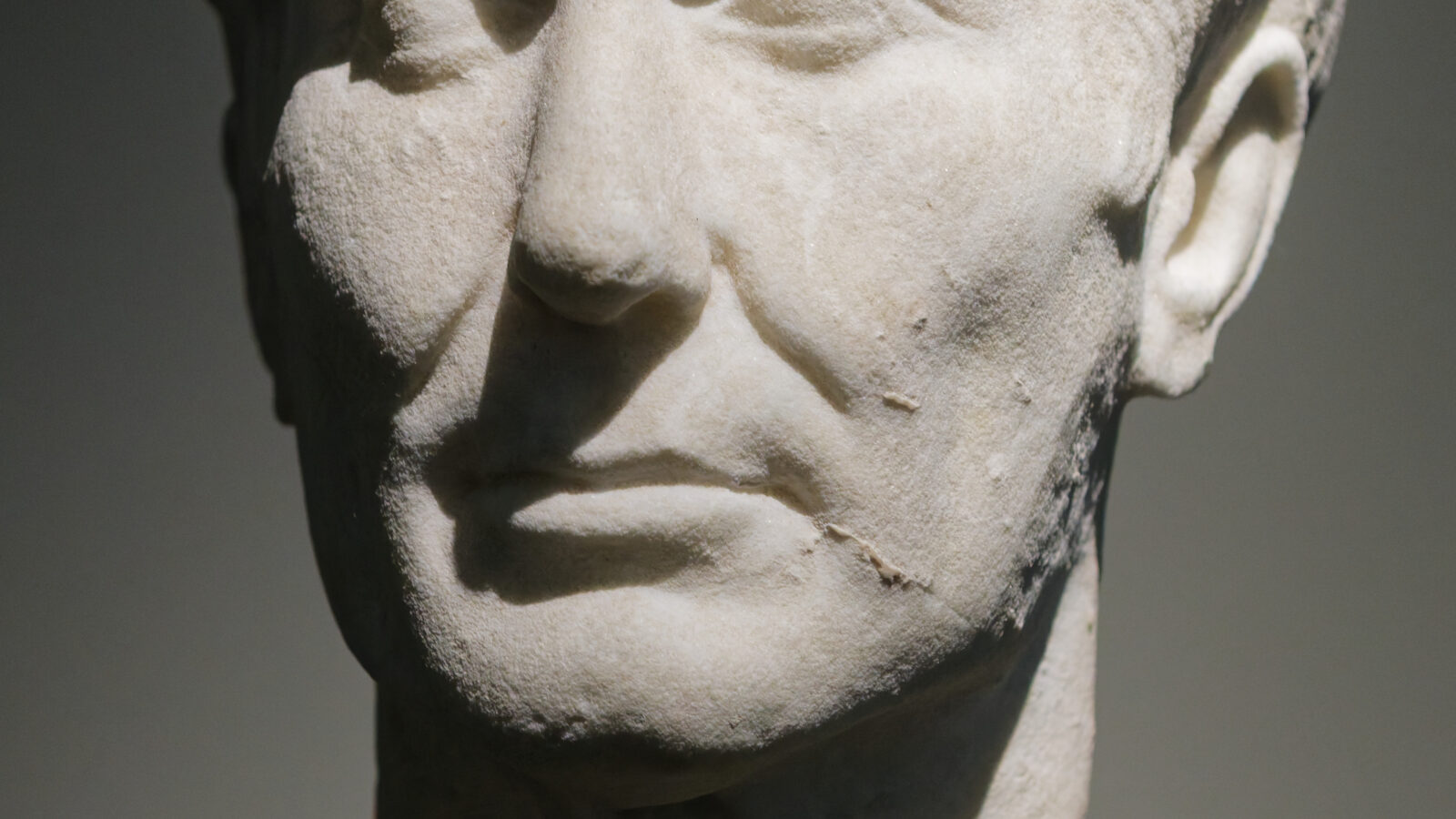
Yes: Julius Caesar appears to have suffered noticeable hair loss. The clearest ancient account comes from Suetonius, who says Caesar was troubled by his baldness, combed his remaining hair forward, and welcomed permission to wear a laurel wreath. That is good evidence for a receding or thinning hairline, not proof that his entire scalp was bare.
The useful question is therefore not whether a modern illustration makes him bald enough. It is how closely that illustration follows the surviving evidence. For his wider appearance, see what Julius Caesar really looked like.
What does Suetonius actually tell us?
In Life of Julius Caesar, chapter 45, Suetonius connects three things: hair loss, ridicule from opponents, and efforts to conceal the thinning area. His description of hair combed forward implies that some hair remained.
Suetonius also records, in chapter 51, a mocking song attributed to Caesar’s soldiers during his triumph. Its reference to baldness shows how the trait entered the anecdotes surrounding Caesar. However, the song survives through the same later author. It is not an independently preserved recording of soldiers singing in the street.
That distinction matters. Suetonius wrote in the early second century CE, well after Caesar’s death in 44 BCE. His work preserves earlier material, but combines historical information with character sketches, gossip, and memorable stories. We should attribute the details to him rather than pretend to possess a contemporary medical record.
Was the laurel wreath just a cover for baldness?
Suetonius says Caesar especially appreciated the privilege of wearing a laurel wreath continually. In his explanation, the wreath helped with a physical insecurity. But reducing the object to an ancient disguise would miss its political meaning: it was also a public honour associated with victory.
Both functions could coexist. A ruler might welcome an honour partly because it improved how he appeared. The source gives us a reason Caesar reportedly liked the wreath; it does not establish that hiding hair loss was the only reason he wore it.
What can coins and portraits contribute?
Portraits and coin images can help us compare hairlines and the way Caesar was represented. They cannot count missing hairs or tell us precisely when thinning began. A small coin portrait is a designed image, and a sculpted hairstyle may be stylized, copied, damaged, or restored.
Identification is another difficulty. A sculpture labelled Caesar today is not automatically a securely identified portrait from his lifetime. The visual evidence should be assessed by date, provenance, and comparison, not simply gathered into a gallery of similar-looking heads.
Can we diagnose the cause?
No reliable diagnosis follows from the surviving descriptions. Calling it a familiar pattern of adult hair loss may sound plausible, but plausibility is not a clinical finding. We do not have the observations needed to establish a specific condition, its onset, or its progression.
The same restraint applies to numbers. Hair loss has relatively direct literary testimony; Caesar’s exact height is a different question with a different evidential basis. Confidence about one physical trait should not spill over into confidence about all the others.
The answer in perspective
Caesar’s baldness is not merely a modern invention. Ancient tradition explicitly describes it. The safest reconstruction is a man with noticeable hair loss who reportedly tried to make it less conspicuous—not a precisely documented scalp, and not an excuse to diagnose him from a bust.
Frequently asked questions
Was Julius Caesar bald?
Ancient accounts describe substantial hair loss. That does not establish that he had no hair anywhere on his scalp.
Did Caesar use a laurel wreath to hide his baldness?
Suetonius links Caesar’s pleasure in wearing the wreath to his hair loss. The wreath was also an important public honour.
Do we know what caused Caesar’s hair loss?
No. The surviving evidence does not support a confident medical diagnosis.