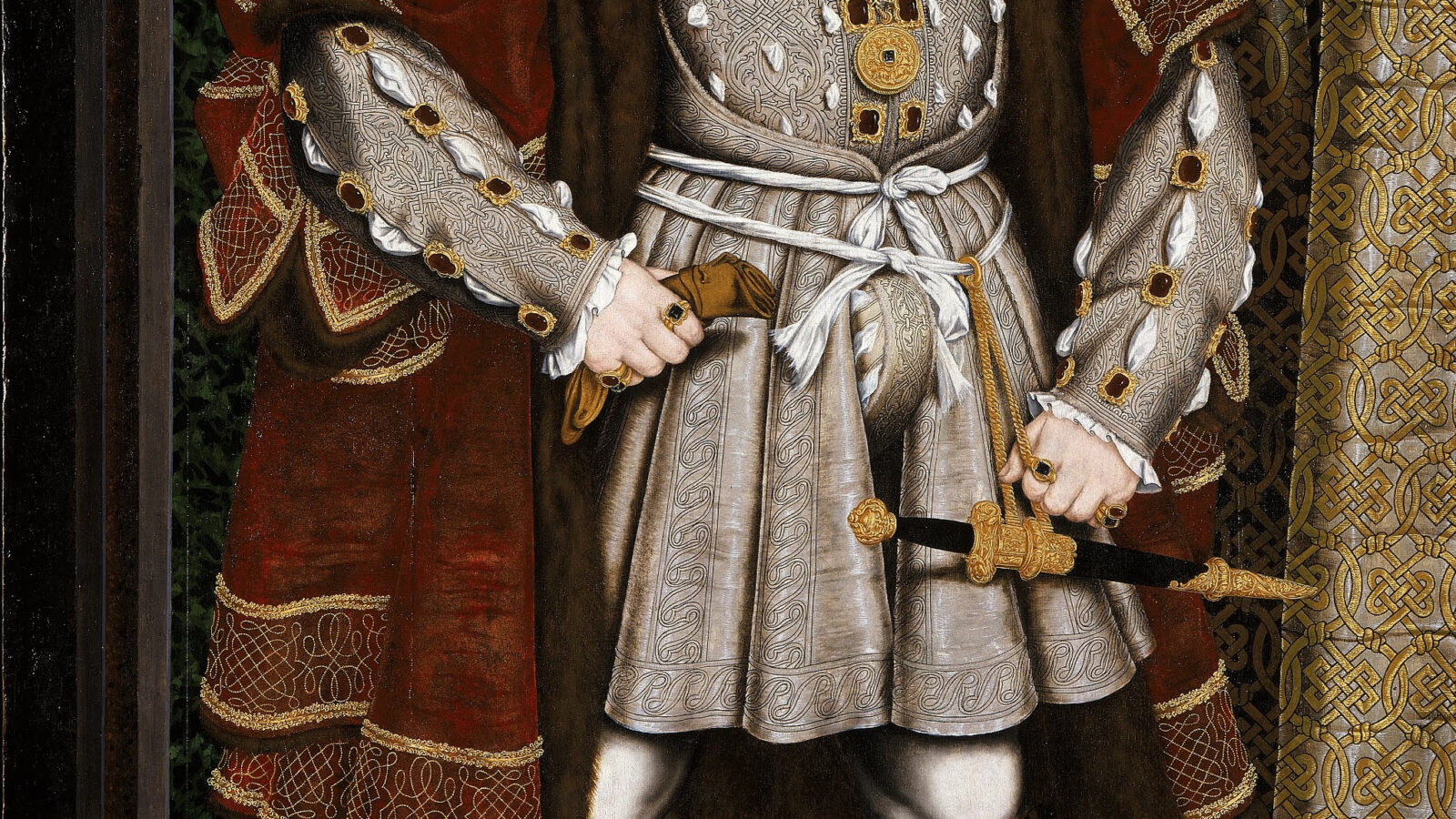
No: Henry VIII was not always the overweight older king familiar from portraits. Evidence for his youth describes an active, athletic man. Surviving armour from different stages of his reign shows a substantial change in his girth, while later accounts describe declining mobility.
This is a question about change over time, rather than a new estimate of Henry VIII’s height. A tall adult can become considerably heavier without growing taller. The armour helps us keep those two measurements separate.
Start with dated armour, not one famous portrait
Each suit belongs to a particular moment and purpose. Field armour, tournament armour, and foot-combat armour are not interchangeable samples. Before comparing them, we need to know when they were made, whether they were fitted to Henry, and whether they were subsequently altered.
The Royal Armouries’ Tudor resource describes an early suit as evidence for a king with a waist around 38 inches. That is an estimate drawn from an object, not a standardized measurement taken at a modern medical appointment.
The museum’s 1520 foot-combat armour provides another early reference point. Its specialized construction also reminds us why measuring a suit’s outside dimensions is not the same as measuring the wearer’s body.
What changes in the later armour?
The Royal Collection describes armour from about 1540 that could accommodate Henry’s expanding waistline. Adjustable fittings are especially useful evidence: they are part of how a real garment was adapted to a real wearer, rather than an artist’s decision about how impressive a monarch should look. See the Royal Collection’s account of Henry’s armour at Windsor.
The important conclusion is the direction and scale of the change, not a falsely exact conversion into kilograms. Armour needs room for underlying clothing and movement. Its shape and adjustments support increasing girth, but do not give us a complete year-by-year weight chart.
Why do published waist figures differ?
Historic Royal Palaces gives a waist of 89 centimetres in Henry’s early twenties and 137 centimetres at about fifty. The early Royal Armouries example refers to a different age and object. These figures should not be forced into a single supposedly contradictory measurement.
A careful comparison labels the date, source, and method beside each number. What counts as the waist measurement, and whether it is reconstructed from armour, matters. The Historic Royal Palaces account also places the later change alongside recurring leg problems and reduced physical activity.
Was the 1536 accident the whole explanation?
Henry’s serious jousting accident in 1536 and painful leg ulcers belong in an account of his later mobility. They do not justify a neat formula in which one event explains all his weight gain, every personality change, and his eventual death.
Historical evidence can establish a changing body and reported difficulties without allowing a definitive retrospective diagnosis. There is no need to attach an unproven modern disorder to make the story interesting.
How should we read the portraits?
Royal portraits communicate authority as well as appearance. Clothing, frontal pose, and the space occupied by the king all affect the impression of breadth. A late portrait should not become an illustration of what Henry looked like at every age.
The better approach is chronological: compare appropriately dated objects and images, then separate direct observations from interpretations. Henry’s familiar late physique was real enough to leave material evidence, but it was not the physique of his entire adult life.
For a wider guide to distinguishing a measurement from an estimate, explore the evidence for famous historical figures’ heights.
Frequently asked questions
Was Henry VIII always overweight?
No. Evidence for the young king describes an athletic man; surviving armour and later accounts show a considerable increase in girth.
Can Henry VIII’s armour tell us his exact weight?
No. Armour dimensions help reconstruct his build, but cannot be converted directly into an exact body weight.
Did Henry VIII’s body change after 1536?
His later life included restricted mobility and increasing girth. The evidence does not prove that one accident alone caused every change.