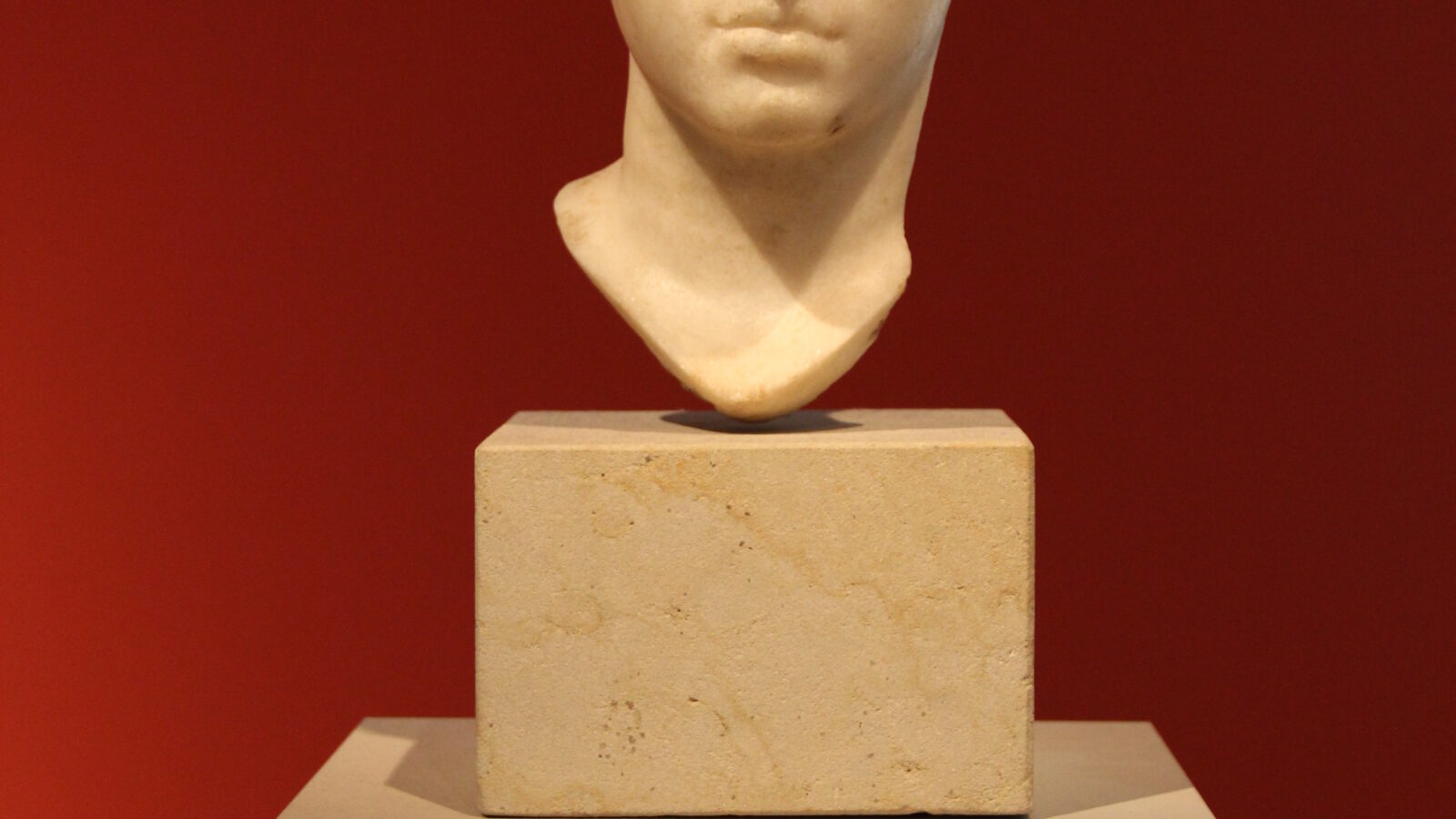
Cleopatra VII was Egyptian in the political and geographical sense: she was born in Egypt, ruled Egypt, and presented herself as an Egyptian pharaoh. Dynastically, however, she belonged to the Ptolemies, a Macedonian Greek royal house that had governed Egypt since the age of Alexander the Great.
So the short answer depends on what “Egyptian” means. Cleopatra was the queen of Egypt and closely engaged with Egyptian religion and language, but her known paternal ancestry was Macedonian Greek. Those statements are not mutually exclusive.
Where was Cleopatra born?
Cleopatra was born in 69 BCE, almost certainly in Alexandria, the capital of Ptolemaic Egypt. The city was founded by Alexander the Great and became a major Greek-speaking centre of government, trade, and scholarship on the Mediterranean coast.
Being born in Alexandria did not make her family ethnically Egyptian in a simple modern sense. The Ptolemaic court remained heavily Greek in language, education, and dynastic practice, while ruling a far older and much larger Egyptian society.
Who were the Ptolemies?
The dynasty began with Ptolemy I Soter, a Macedonian officer and companion of Alexander the Great. After Alexander’s death, Ptolemy took control of Egypt and eventually declared himself king. His descendants ruled for nearly three centuries.
The royal family frequently married within the dynasty, including marriages between siblings. Cleopatra’s father was Ptolemy XII Auletes. Her mother is not securely identified, which leaves part of her ancestry uncertain, but there is no positive evidence that resolves that gap as native Egyptian, sub-Saharan African, or any other specific ancestry.
Did Cleopatra speak Egyptian?
Plutarch credits Cleopatra with speaking many languages and specifically says that, unlike earlier Ptolemies, she learned the Egyptian language. Her primary court language was Greek, but using Egyptian distinguished her from her predecessors and strengthened her connection with the population she ruled.
Language was political as well as personal. A ruler who could address different groups without an interpreter gained practical and symbolic advantages in a multilingual kingdom.
Did Egyptians regard Cleopatra as a pharaoh?
Cleopatra participated in Egyptian kingship. Temple reliefs show her in pharaonic form making offerings to Egyptian deities. She associated herself closely with Isis and supported traditional religious institutions. Egyptian priests dated documents by her reign and represented her within established royal conventions.
This was not merely costume. Ptolemaic rulers governed through both Greek and Egyptian institutions. Cleopatra could appear as a Hellenistic queen on coins and as a pharaoh on temple walls because her monarchy operated in both worlds.
Was Cleopatra Greek instead?
She was Macedonian Greek by dynasty and deeply shaped by Greek language and education. Our article Was Cleopatra Greek? explains that side of her identity in detail. Calling her Greek is defensible when discussing ancestry and court culture; calling her Egyptian is defensible when discussing birthplace, monarchy, and political identity.
The mistake is insisting that one label must erase the other. Ancient identities could be layered, and royal identity was performed differently for different audiences.
What does this tell us about her ethnicity?
Cleopatra’s documented paternal line was Macedonian Greek. The unknown identity of her mother and some earlier female ancestors means her complete ancestry cannot be reconstructed. That uncertainty should be stated honestly rather than filled with a preferred modern answer.
Questions about whether Cleopatra was Black often combine ancestry, appearance, geography, and modern racial identity. Ancient evidence cannot always answer those categories as precisely as modern debate demands.
Final answer: was Cleopatra Egyptian?
Yes—as Egypt’s born-and-raised ruler, as a pharaoh, and as a monarch who used the Egyptian language and religious traditions, Cleopatra was Egyptian. She was also a member of a Macedonian Greek dynasty whose court culture remained Greek.
The most accurate description is therefore not “Egyptian or Greek,” but “the Macedonian Greek queen and pharaoh of Egypt.”
Sources and further reading
- Plutarch, Life of Antony, especially section 27 on Cleopatra’s languages.
- Duane W. Roller, Cleopatra: A Biography.
- Encyclopaedia Britannica, “Cleopatra”.
- Wikimedia Commons: marble portrait of Cleopatra VII (CC0).
Frequently asked questions
Was Cleopatra Egyptian?
Yes in birthplace, kingship, and political identity. Dynastically, she belonged to the Macedonian Greek Ptolemaic house.
Was Cleopatra born in Egypt?
Yes. She was born in 69 BCE, almost certainly in Alexandria.
Did Cleopatra speak Egyptian?
Ancient sources say she learned Egyptian, unlike earlier members of her dynasty.
Was Cleopatra a pharaoh?
Yes. She ruled Egypt and was represented in temples according to pharaonic religious and royal traditions.
Discussion
1 comment
Comments are closed for this article.
[…] another example of why birthplace and cultural background need separating, see whether Cleopatra was Egyptian. The periods are different, but the underlying caution is […]