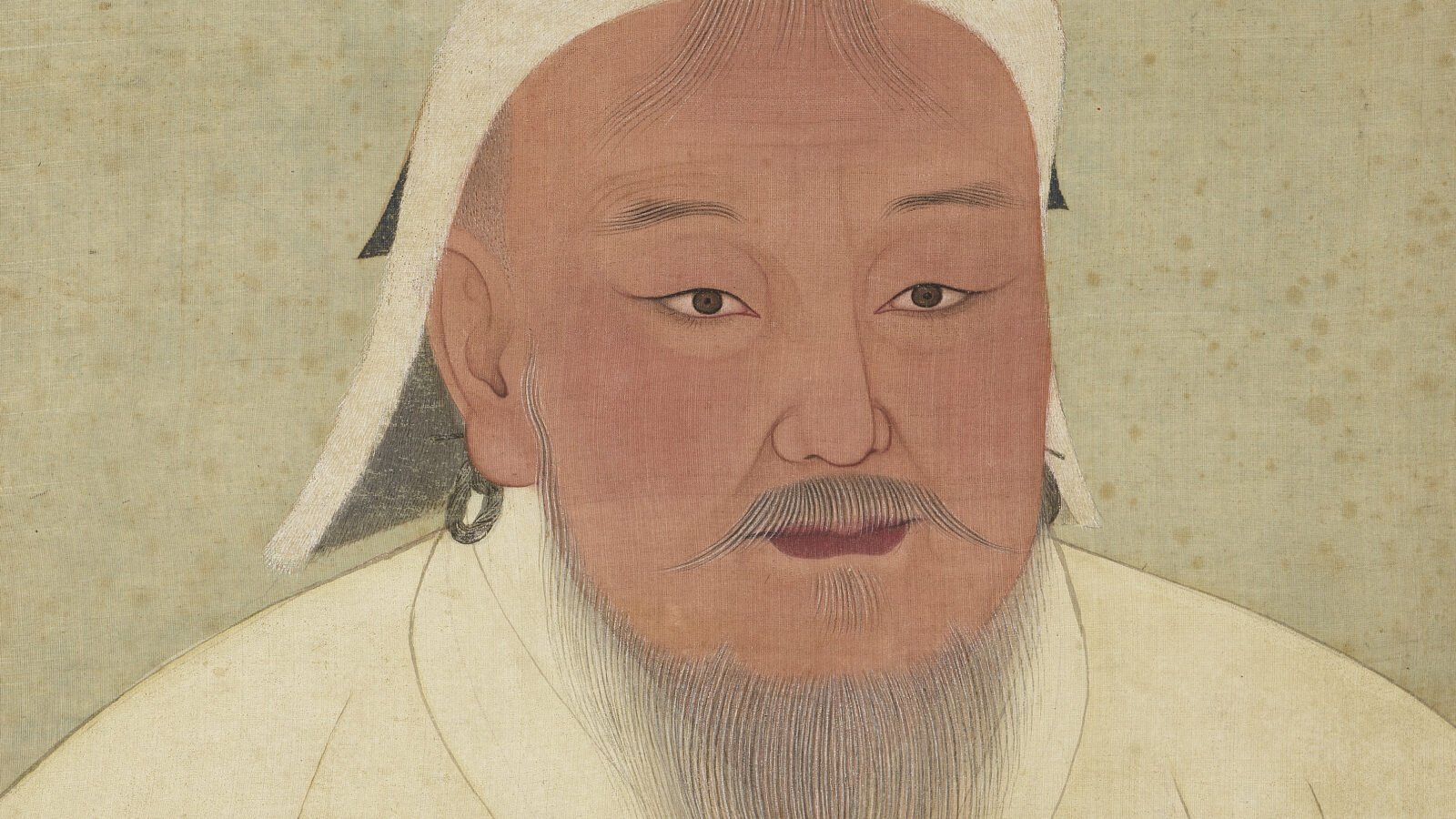
We do not know exactly how tall Genghis Khan was. No reliable contemporary source records his height, and no confirmed set of his remains has been available for scientific measurement. Claims that he stood 6 feet 2 inches, 6 feet 5 inches, or even taller are modern estimates without a secure evidential basis.
The most historically responsible answer is therefore simple: Genghis Khan may have been physically imposing, but his exact stature is unknown. Medieval descriptions tell us more about how later writers wanted readers to imagine a conqueror than about a measurement in feet or centimetres.
Is there a recorded height for Genghis Khan?
No surviving record gives a dependable numerical height for Genghis Khan. The Secret History of the Mongols, the most important early narrative about his life and dynasty, describes his ancestry, rise, battles, family, and political relationships. It does not provide a standardized bodily measurement that can be converted into a modern height.
This absence matters because many online height lists present a precise number without identifying a primary source. Repetition can make an estimate look established, but it does not create evidence. Unless a figure can be traced to a near-contemporary text, a measured object, or securely identified remains, it should not be stated as fact.
What did early writers say about his appearance?
Descriptions associated with Genghis Khan often emphasize striking or auspicious features rather than ordinary anatomy. Rashid al-Din, writing in the early fourteenth century under the Mongol Ilkhanate, preserved traditions about the Borjigin family having distinctive colouring. Other accounts describe a broad or powerful presence. These texts were produced in literary and political settings in which physical appearance could signal legitimacy, charisma, or heroic ancestry.
Such language is not useless, but it is not a medical report. “Large,” “strong,” or “majestic” can describe bearing, reputation, and ideal kingship as much as body size. Translators also have to choose modern words for expressions whose original meaning may not map neatly onto present-day categories.
Why can’t his skeleton settle the question?
Genghis Khan’s burial place has never been conclusively identified. Historical tradition holds that he was buried secretly after his death in 1227, probably somewhere in Mongolia. Archaeologists have investigated landscapes associated with him, but there is no universally accepted tomb and no authenticated skeleton from which stature could be reconstructed.
Even if a plausible grave were found, identification would require much more than a tall male skeleton. Archaeological context, dating, genetics, burial practice, and comparison with known relatives would all matter. Long bones can support a stature estimate, but only after the individual has been securely identified.
Where do the exact numbers online come from?
Most precise claims appear to be unsourced modern reconstructions. A writer may infer that a successful mounted warrior was tall, borrow a number from another website, or convert a vague description into feet and inches. Search results then repeat the same figure until its speculative origin disappears.
There is also a familiar storytelling pattern at work. Famous conquerors are often imagined as physically exceptional, even though political skill, alliances, logistics, and military organization mattered far more than height. The same attraction to exact numbers affects claims about Alexander the Great’s height and Julius Caesar’s height.
Would a tall man have had an advantage as a Mongol warrior?
Not necessarily. Mongol warfare depended on horsemanship, archery, discipline, mobility, intelligence, and coordinated command. Riding skill and endurance mattered more than reaching an exceptional stature. Body size can influence individual combat, but it does not explain the expansion of the Mongol Empire.
Modern average-height data cannot solve the question either. Populations vary across time and region, while elite childhood nutrition may differ from that of the wider population. An average for medieval Mongolian men would not tell us how tall one particular ruler was.
Final answer: how tall was Genghis Khan?
Genghis Khan’s exact height is unknown. There is no trustworthy contemporary measurement and no confirmed skeleton. Descriptions of a powerful or striking man may preserve something about his appearance, but they cannot justify a precise modern figure.
If a website gives one exact height without a primary source, treat it as speculation. Genghis Khan belongs in the “unknown” category in any comparison of the heights of famous historical figures.
Sources and further reading
- Igor de Rachewiltz, The Secret History of the Mongols: A Mongolian Epic Chronicle of the Thirteenth Century.
- Rashid al-Din, Jamiʿ al-Tawarikh (Compendium of Chronicles).
- Wikimedia Commons: traditional Yuan dynasty portrait of Genghis Khan (public domain).
Frequently asked questions
How tall was Genghis Khan?
His exact height is unknown. No reliable contemporary measurement and no confirmed skeleton survive.
Was Genghis Khan over six feet tall?
Possibly, but there is no dependable evidence for a specific figure. Precise claims online are modern speculation.
Do we have Genghis Khan’s remains?
No confirmed remains or universally accepted tomb have been identified, so his stature cannot be reconstructed from bones.
Is the famous portrait an eyewitness likeness?
No. The traditional Yuan dynasty portrait is a later court image rather than a portrait made from life.