I’ve been to Switzerland many times, and we always visit the Bernese Alps.
In the Bernese Alps, three peaks dominate the landscape: the Eiger, the Mönch, and the Jungfrau. Beautiful mountains, rising above the valleys. They are among the most recognizable and photographed mountains in Switzerland, forming a natural skyline that defines the region.

And in a landscape as magnificent as the Bernese Alps, natural features rarely felt random. They needed interpretation.
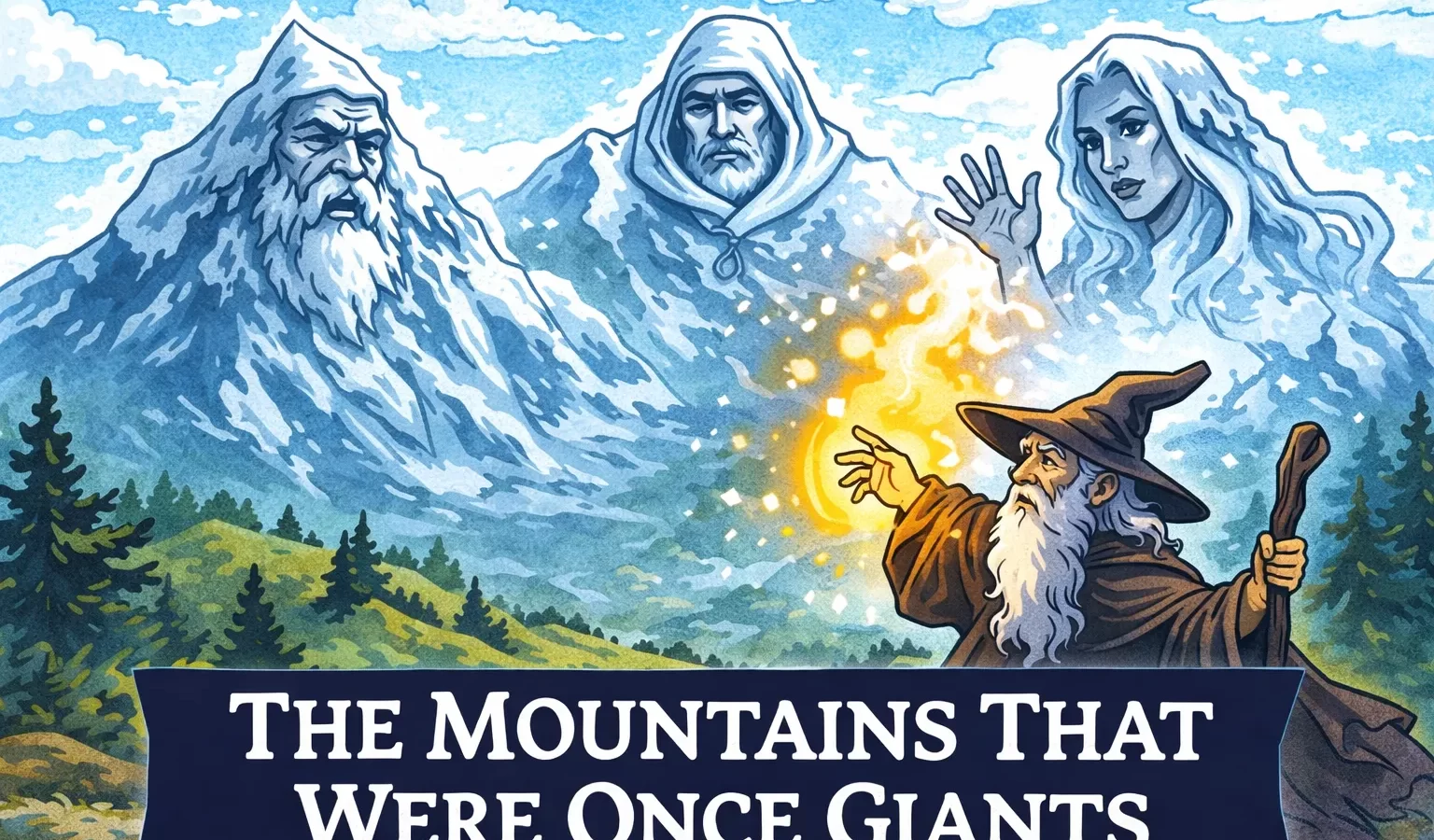
According to local folklore, these mountains were not always mountains.
The Legend of the Triumvirate
High above the valley of Grindelwald, on the alpine pastures of the Wengernalp, a family of giants was said to live:
- A father
- Two sons
- And a daughter
They were powerful, self-contained, and indifferent to the world below.
One day, an old traveler passed through the mountains and asked them for something simple: a sip of milk.
The giants refused.
Not out of necessity, but out of disregard — they didn’t care.
What they did not know was that the traveler was no ordinary man. He was a mountain spirit.
The Transformation
As a punishment for the giants, the spirit turned them into stone and ice.
The father became the Eiger.
The sons became the dark and pale forms of the Mönch.
And the daughter became the Jungfrau — the “maiden.”
The landscape itself became a frozen consequence.
A permanent reminder.
Reading the Landscape
This legend is not created randomly.
It follows a pattern that appears across many Alpine regions: explaining geography through transformation. Mountains are not just physical structures.
They are interpreted as outcomes.
The story maps human characteristics onto terrain:
- The Eiger, steep and imposing, becomes a figure of strength and severity
- The Mönch, positioned between, acts as a divider or mediator
- The Jungfrau, bright and glaciated, becomes purity preserved
The Morality
In its most basic form, the legend is simple: there’s a request, denied, and punishment follows. Just like in the story of Beauty and the Beast, where the old lady turns out to be a mystical sorceress and turns the prince into a hideous beast.
This reflects a recurring theme in Alpine folklore:
- Hospitality is expected, even in isolation
- Refusal is not neutral, it carries consequence
- Nature enforces what society cannot
Why This Story Exists
In high mountain environments, survival often depends on working together with the people around you.
Travelers do this all the time, they rely on others while resources are limited. Stories like this function as reinforcement mechanisms.
The mountain spirit is not really a character in this story but more a representation of the environment and the social culture in the Alps.
Conclusion
This story is not just about giants, you can use this to read the Alps. Where modern explanations rely on geology and time, older narratives relied on transformation and consequence.
The mountains are not just there.
They are the result of something. And in this version, they stand as a reminder:
In places where survival is uncertain, even a small refusal can become permanent.