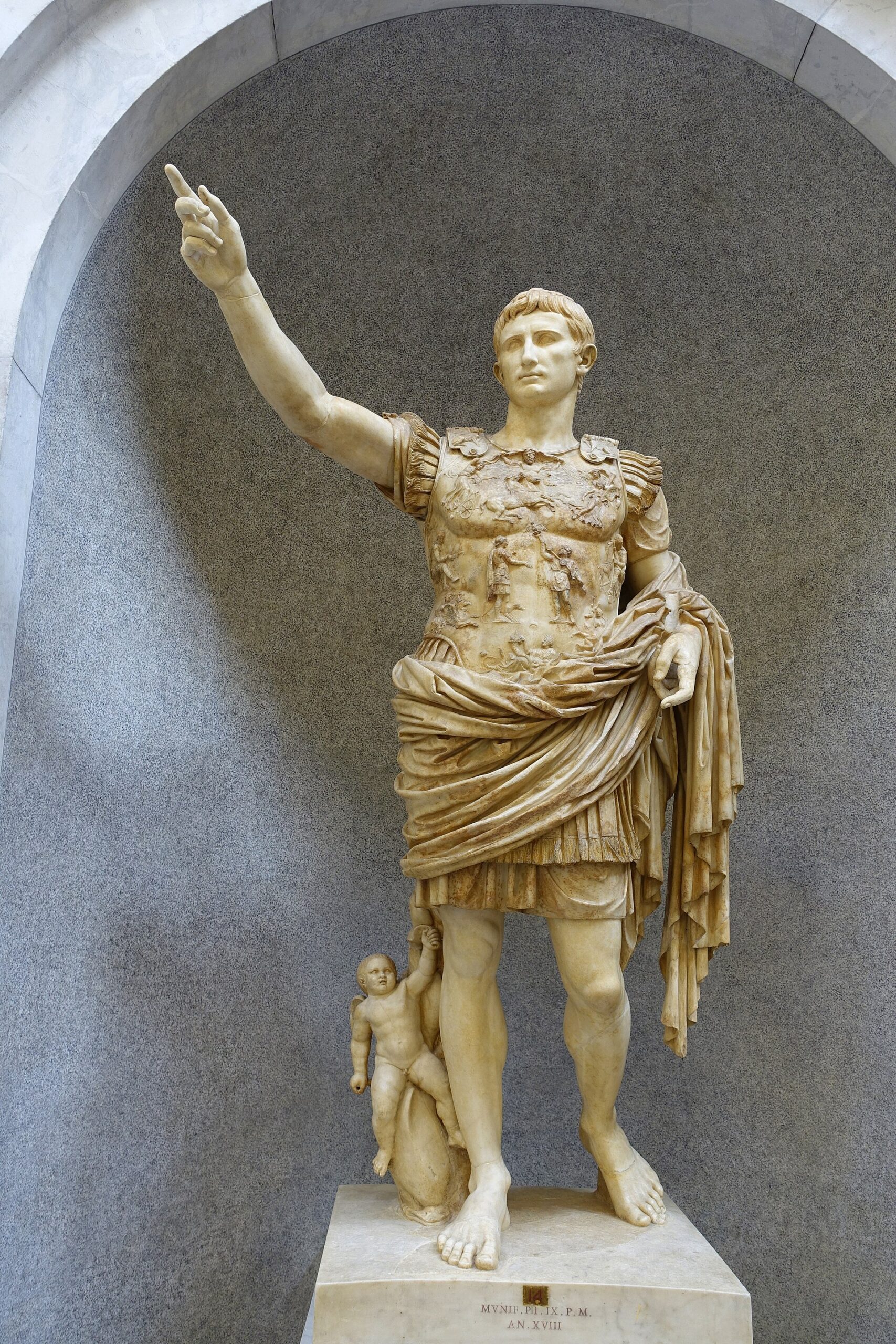
Augustus’s surviving portraits show a recognizable youthful public image: carefully arranged hair over the forehead, an orderly face, and a composed expression. They are valuable evidence for how he was represented, but not a photographic record of every feature. Suetonius supplies a more personal description, written after Augustus’s lifetime.
The most useful reconstruction puts those sources beside one another without assuming that either is completely neutral. A ruler’s official image and an author’s character portrait serve different purposes.
What does the Meroë head show?
The British Museum’s bronze Meroë head comes from an over-life-sized statue of Augustus. Its catalogue describes the distinctive arrangement of forehead hair, broad facial planes, and inset eyes made with glass and stone.
The head is an unusually vivid example because the eyes survive. Its scale and balanced proportions nevertheless belong to an official representation of an emperor. The museum relates its ideal form to Classical Greek conventions and explains the role of coins and statues in circulating imperial imagery.
That means it gives strong evidence for a portrait type and its political effect. It gives weaker evidence for exactly how Augustus’s face would have looked in ordinary light, unposed, at a particular age.
What did Suetonius describe?
In Life of Augustus, chapter 79, Suetonius describes slightly curly hair tending toward golden, eyebrows that met, imperfect teeth, and a distinctive nose. He also describes bright eyes and a calm expression.
These are reported observations, not details independently verified by a preserved body. Suetonius mixes physical description with stories about the emperor’s presence and the impression his gaze made on other people. The account therefore helps us reconstruct a tradition about Augustus, while also revealing the author’s way of presenting him.
It would be misleading to lift a hair-colour phrase from the passage and treat it as a precise modern colour swatch. Likewise, a dramatic description of the eyes should not become a confident genetic or medical claim.
Why does an idealized portrait still matter?
Idealization does not mean that an image is useless or entirely invented. It means likeness was selected and shaped to do a job. Recognizable features could help viewers identify the ruler; an orderly, composed presentation could communicate how authority was supposed to look.
A helpful question is therefore “What did viewers recognize?” rather than “Which statue is a perfect scan?” Details recurring across identified portraits may belong to the established public likeness. Their repetition alone does not prove that every detail was anatomically exact.
What can we say about ageing and colour?
An official portrait need not record the subject’s age with the candour of an informal photograph. Nor does bare stone tell us the original colour scheme of every sculpture. Absence of colour on an object as displayed today is not positive evidence for a pale complexion or white hair.
Different materials answer different questions. A bronze head with inset eyes, a coin profile, and a marble statue are not interchangeable sources. Their dates, preservation, and intended audiences matter before they can be combined into one reconstruction.
What belongs outside the portrait?
A head cannot establish full-body height. That question has a separate literary measurement and a unit-conversion problem, examined in how tall Augustus was.
For a comparison of similar evidence, see Caesar’s surviving likenesses and Cleopatra’s coins and portraits. The point is not to reconstruct one universal ancient face, but to evaluate each figure’s evidence separately.
We can recover a convincing public image of Augustus and several reported personal traits. We cannot honestly turn them into a fully authenticated photograph.
Frequently asked questions
Do we know what Augustus looked like?
Surviving portraits and ancient descriptions preserve useful evidence, but official images were idealized and do not settle every physical detail.
Were statues of Augustus realistic?
They combined recognizable features with an idealized image of imperial authority. They should not be treated as neutral anatomical records.
Do Augustus’s portraits prove his hair colour?
No. Suetonius describes hair tending toward golden, but that is a later literary report; a monochrome sculpture does not independently verify it.