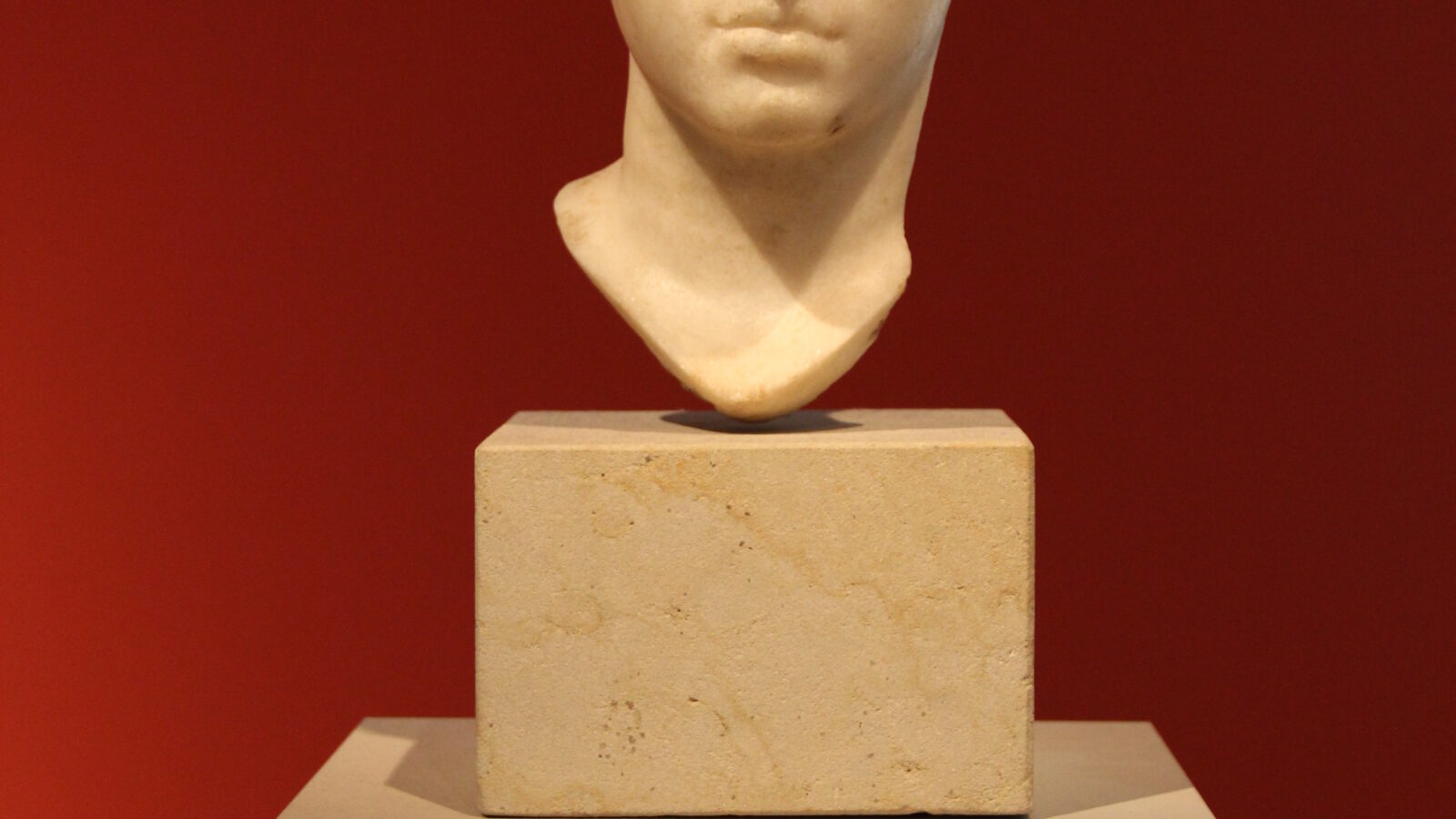
Cleopatra VII probably had a prominent nose, a strong jaw, a rounded or projecting chin, and tightly arranged hair gathered into a bun. That reconstruction comes mainly from coins issued during her reign and a small group of sculpted heads that scholars associate with her.
We cannot identify her exact skin tone, eye colour, or every facial detail with confidence. Hollywood images and later European paintings tell us far more about their own periods than about the queen who ruled Egypt from 51 to 30 BCE.
What is the closest evidence to Cleopatra’s lifetime?
Coins are the most securely dated portraits connected to Cleopatra’s rule. They name her and were issued by her government or in political alliance with Mark Antony. Several show a hooked or aquiline nose, a firm chin, large eyes, and hair drawn back beneath a royal diadem.
Coin images are stylized. They had to remain legible on a small metal surface and could borrow the visual language of earlier Ptolemaic rulers. Some paired coins also make Cleopatra and Antony resemble one another, reinforcing their joint authority rather than offering two neutral portraits.
Which sculptures may show Cleopatra?
The “Berlin Cleopatra” and a Vatican portrait are often identified as the queen. Their hairstyle and diadem resemble features associated with Ptolemaic royalty, while their facial structure has been compared with the coins. The British Museum also holds a marble head that may depict Cleopatra, but the museum explicitly notes that the identification is uncertain.
That uncertainty is normal in ancient portraiture. A sculpture can lose its original inscription and archaeological context, while fashionable elite women may imitate a royal hairstyle. Similarity is evidence, but it is not absolute proof.
Was Cleopatra considered beautiful?
Plutarch, writing more than a century after her death, says her beauty was not in itself incomparable. He emphasizes instead her conversation, voice, intelligence, and compelling presence. The passage is often reduced to the idea that she “was not beautiful,” but Plutarch’s point is that her attraction could not be captured by appearance alone.
Ancient judgements of beauty were shaped by status, rhetoric, and political hostility. Roman authors writing after Octavian’s victory had reasons to portray Cleopatra as dangerously seductive or morally corrupt. Neither praise nor condemnation is a mirror.
Can we reconstruct her skin colour?
No surviving portrait provides a dependable colour record. Marble may once have been painted, coins are monochrome, and later paintings are imaginative. Cleopatra belonged to the Macedonian Greek Ptolemaic dynasty, but parts of her family tree—especially the identity of her mother—remain uncertain.
Modern racial categories do not map cleanly onto the ancient Mediterranean. Questions about whether Cleopatra was Greek, Black, or Egyptian need to distinguish dynasty, birthplace, language, culture, and unknown ancestry instead of treating them as one thing.
Why do modern portrayals look so different?
Every era remakes Cleopatra. Renaissance and Baroque artists used contemporary European ideals. Nineteenth-century painters imagined an exotic queen. Cinema selected stars who could embody glamour for modern audiences. These works shaped cultural memory even when they ignored the coin portraits.
A historically grounded depiction would begin with the diadem, centrally parted and bound hair, a bun at the back, and the strong profile visible on her coins. It should still acknowledge that the evidence cannot produce a photographic reconstruction.
Final answer: what did Cleopatra really look like?
Cleopatra’s coins and likely sculptures suggest a strong-featured woman with a prominent nose and chin, large eyes, and hair drawn back into a bun beneath a royal diadem. Those recurring features are more reliable than later paintings and films.
Her precise colouring and the exact shape of her face remain uncertain. The evidence also tells us nothing secure about Cleopatra’s height.
Sources and further reading
- Plutarch, Life of Antony, especially section 27.
- British Museum, possible portrait head of Cleopatra VII.
- Wikimedia Commons: marble portrait of Cleopatra VII (CC0).
Frequently asked questions
Do we know what Cleopatra looked like?
Coins issued during her reign and several possible sculpted portraits preserve a plausible likeness, but not every detail is certain.
Was Cleopatra beautiful?
Plutarch emphasized her voice, intelligence, conversation, and presence rather than claiming that her physical beauty was incomparable.
What hairstyle did Cleopatra wear?
Many portraits show centrally parted hair drawn back into a bun and held by a royal diadem.
Can portraits prove Cleopatra’s skin colour?
No. Coins are monochrome, marble may have lost paint, and later paintings are imaginative.