Ancient Romans were not all one height, but skeletal studies suggest that many Roman-period men were roughly 165–170 centimetres tall (about 5 feet 5 inches to 5 feet 7 inches), while women were often around 152–158 centimetres (about 5 feet to 5 feet 2 inches). Those are broad population patterns, not a single empire-wide average.
Height varied with date, region, ancestry, childhood nutrition, disease, social conditions, and the archaeological sample being studied. A Roman citizen in Britain, a farmer in Egypt, and an elite resident of the capital did not necessarily share the same stature.
How do historians estimate Roman height?
Researchers usually estimate stature from long bones such as the femur and tibia. Measurements are entered into regression equations derived from known relationships between bone length and standing height. The result is a range or estimate, not a perfect reconstruction.
That method works best for a single excavated population with clear dating and preservation. Combining many cemeteries into one “Roman average” introduces differences in method, geography, sex estimation, chronology, and social composition.
What do Roman skeletal studies show?
A study of the Roman Imperial community at Muracciola Torresina near Rome reported an average estimated stature of 167.3 centimetres for men and 157.3 centimetres for women. Other sites produce somewhat different figures. The useful conclusion is a band of variation rather than a universal number.
Many Roman men would therefore look shorter than the average man in several modern European countries, but not dramatically miniature. Plenty of individuals were taller or shorter than the mean. Averages describe populations; they do not determine the stature of every legionary, senator, or emperor.
Were Roman soldiers taller than civilians?
The Roman army valued physical fitness and sometimes used height standards, but recruitment needs changed across centuries and frontiers. Ancient measurements must also be converted carefully because the Roman foot was shorter than the modern English foot.
Military cemeteries may contain selected groups, yet soldiers came from many provinces. A unit stationed on the Rhine could include men raised far from Italy. It is misleading to treat one legionary sample as the body type of all Romans.
Did wealth and diet affect height?
Adult height partly reflects conditions during childhood. Repeated infection, food shortage, and poor sanitation can suppress growth, while a stable diet and lower disease burden can help children reach more of their genetic potential. Roman cities offered access to diverse foods but also exposed residents to crowding and disease.
Status did not produce a simple tall-rich, short-poor divide at every site. Enslaved people, migrants, rural communities, and urban elites lived under different conditions, and burial samples rarely preserve society in perfect proportion.
Were people shorter because they lived in the past?
Human genetic potential did not suddenly change after antiquity. Historical height responds strongly to environment. Modern increases in average stature in some countries are associated with nutrition, sanitation, medical care, and reduced childhood disease—not with ancient people belonging to a fundamentally smaller kind of human.
There were tall Romans and short Romans, just as there are today. The difference lies mainly in how the distribution shifted under particular living conditions.
How does this affect claims about famous Romans?
A population average cannot reveal the height of an individual without direct evidence. We do not have securely identified remains or a reliable numerical measurement for Julius Caesar. Saying that he must have matched an average Roman male would replace one unknown with an assumption.
The same caution applies to portrait busts. Artists adjusted proportions for visual and political reasons, and a head does not establish total stature.
Final answer: how tall were Ancient Romans?
Many Roman-period male samples average somewhere around 165–170 centimetres, while female samples often fall around 152–158 centimetres. Individual sites can lie outside those bands, and the Roman Empire was too large and diverse for one exact average.
The best answer names the population, period, and method. “Romans were 5 feet 5 inches tall” is memorable, but it is much less accurate than the varied archaeological record.
Population averages also provide context for individual questions about Cleopatra’s height and Alexander the Great’s height, although neither ruler’s exact stature is securely recorded.
Sources and further reading
- Bioarchaeological study of the Roman Imperial community at Muracciola Torresina, Journal of Archaeological Science: Reports.
- Rebecca Gowland and Tim Thompson, eds., Human Identity and Identification (for methods and limits in skeletal interpretation).
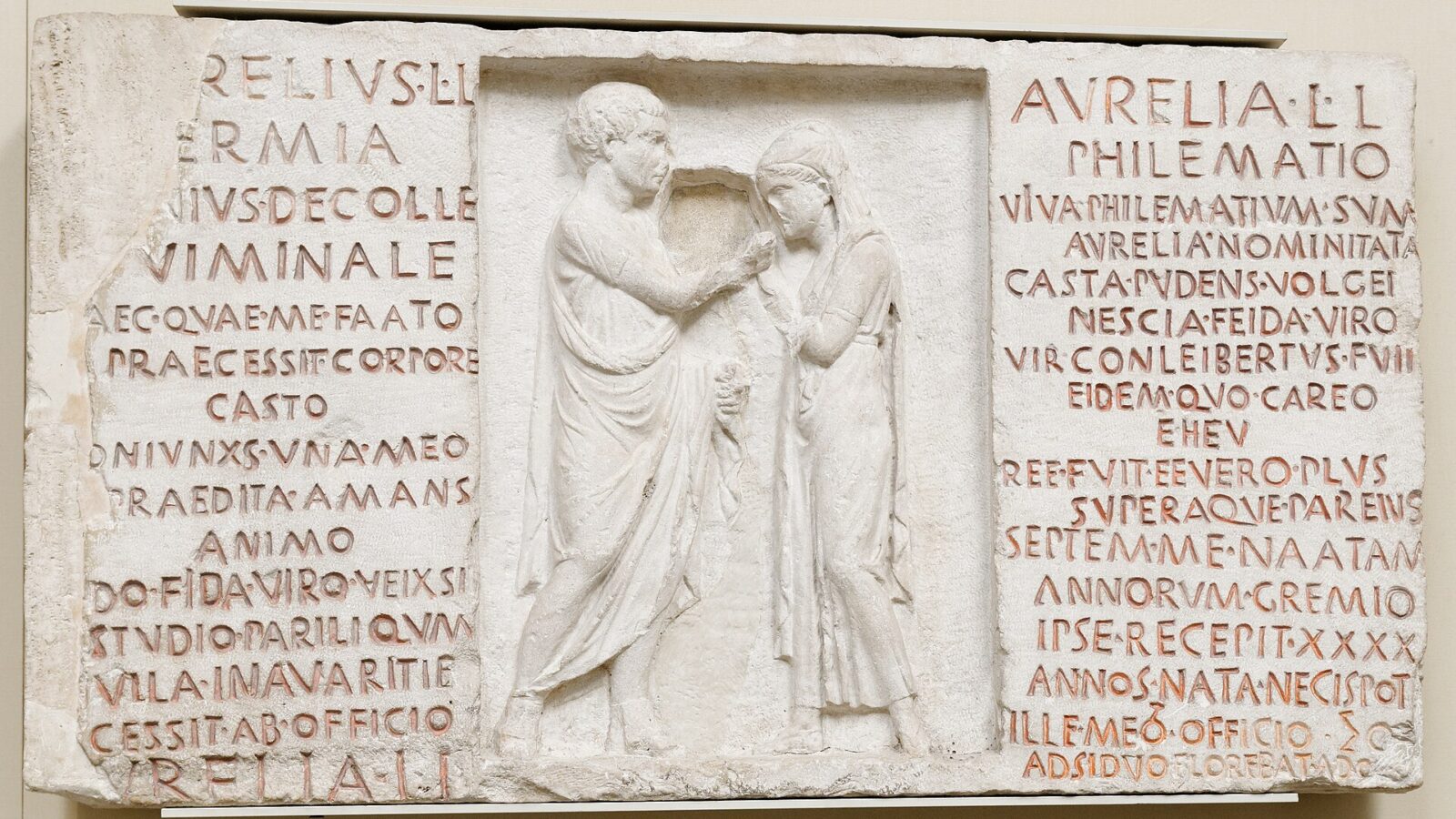
- Wikimedia Commons: funerary stele of Aurelius Hermia and Aurelia Philematium (public domain).
Frequently asked questions
What was the average height of an Ancient Roman man?
Many Roman-period male samples fall around 165–170 centimetres, but the result varies by place, period, and method.
How tall were Ancient Roman women?
Female skeletal samples often average around 152–158 centimetres, with meaningful regional variation.
Were Roman soldiers taller than civilians?
The army valued physical fitness and sometimes used height standards, but soldiers came from many regions and no one figure applies to every legion.
How is Roman height calculated?
Researchers estimate stature from long bones such as the femur and tibia using regression equations.