Charlemagne was probably about 1.84 metres tall, or roughly 6 feet. That figure comes from a modern study of a left tibia attributed to him, not from a measurement taken during his lifetime, so it is best treated as a well-supported estimate rather than an exact fact.
The evidence agrees on the broader point: Charlemagne was unusually tall for a man of the Carolingian period. Einhard, a member of his court, described him as tall and strongly built, while the surviving bone produced a stature estimate well above the contemporary male average used by the researchers.
What do historical sources say about Charlemagne’s height?
The main written description comes from Einhard’s Life of Charlemagne. In chapter 22, Einhard describes Charlemagne as large and strong, with an elevated or commanding stature that did not exceed proper proportion. He adds that Charlemagne’s height was “seven of his own feet.”
That wording is important. Einhard did not say that Charlemagne was seven modern English feet tall. He described a bodily proportion: about seven times the length of Charlemagne’s own foot. A “foot” in this sentence is not a standardized ruler that can simply be converted into inches or centimetres.
Einhard also gives a fuller physical portrait. Charlemagne had a rounded head, large and lively eyes, a slightly long nose, fair or greying hair, and a cheerful expression. His neck was described as somewhat short and thick, and his stomach as prominent, although Einhard says the overall proportions of his body concealed these features.
How reliable is Einhard?
Einhard is unusually valuable because he belonged to Charlemagne’s court and knew the world he was describing. He wrote in the early ninth century, close to Charlemagne’s lifetime, and his account is much nearer to the emperor than the heroic romances and royal portraits produced centuries later.
He was not a neutral observer, however. Einhard admired Charlemagne, served his dynasty, and shaped his biography partly after Suetonius’ lives of the Roman emperors. The description is informed testimony, but it is also court biography. Words such as “strong,” “well-proportioned,” and “commanding” helped present an ideal ruler.
The safest reading is therefore not that every detail is a precise measurement. It is that a well-placed near-contemporary remembered Charlemagne as conspicuously tall without describing him as grotesquely oversized.
Does “seven feet” mean Charlemagne was seven feet tall?
No. The popular claim that Charlemagne stood seven feet tall—about 2.13 metres—comes from reading Einhard’s phrase as though it used a modern unit. The Latin refers to seven of Charlemagne’s own feet.
Human height is often a little more than six and a half to seven foot-lengths, depending on how both measurements are taken. Einhard may have been reporting a remembered proportion rather than the result of a formal measurement. We do not know the length of Charlemagne’s foot, the measuring procedure, or how exact the number seven was intended to be.
So the passage supports the idea that he was tall and proportionate. It does not support a confident claim of seven modern feet.
Can we estimate Charlemagne’s height from his remains?
A 2010 study by Frank Rühli, Maciej Henneberg, and colleagues examined a left tibia kept in the treasury of Aachen Cathedral and attributed to Charlemagne. The bone measured 430 millimetres. Using established stature-estimation formulas, the researchers reconstructed a height of about 1.84 metres, with different methods producing estimates roughly between 1.79 and 1.92 metres.
This is the strongest numerical evidence available, but it still has limits. Stature formulas provide estimates, not tape-measure readings. Different equations produce different results, and the calculation depends on the identification of the relic. Scientific examinations have found the remains consistent with what is known about Charlemagne, but historical identification after more than twelve centuries cannot offer the certainty of a modern medical record.
For that reason, “about 1.84 metres” is more defensible than a highly precise figure such as 184.2 centimetres. The extra decimal places would suggest a certainty the evidence does not possess.
How tall was Charlemagne compared with men of his time?
The 2010 study compared the reconstructed height with medieval skeletal data and placed Charlemagne near the 99th percentile. It used about 1.69 metres—roughly 5 feet 6½ inches—as a comparative average for a medieval man.
That average should not be treated as a universal Carolingian standard. Medieval height varied by region, social conditions, childhood nutrition, disease, and the sample of skeletons being studied. Even so, a man around 1.84 metres would have stood out in most early medieval groups. He may have been about 15 centimetres taller than the comparison average.
This makes Einhard’s description plausible. The text and the biological estimate are independent kinds of evidence, and both point in the same direction: Charlemagne was notably tall, even if neither gives us a perfectly exact measurement.
Charlemagne is therefore one of the better-supported cases in our overview of how tall famous historical figures were. His estimate rests on surviving biological evidence as well as a near-contemporary description, while figures such as Alexander and Caesar have left no confirmed remains from which to calculate stature.
Why do modern websites give such precise numbers?
A precise number is easier to repeat than an explanation. Einhard’s “seven feet” becomes seven modern feet; the study’s central estimate becomes a fixed height; and a calculated metric value is converted into feet and inches as though someone had measured Charlemagne while he was alive.
The same process can turn a cautious estimate into a popular myth. The persistent claim that Napoleon was unusually short, for example, also depends on removing measurements from their historical context.
Those shortcuts collapse several different claims:
- Near-contemporary description: Einhard remembered Charlemagne as tall and well-proportioned.
- Reported proportion: Einhard wrote that his height was seven times his own foot-length.
- Skeletal estimate: a tibia attributed to Charlemagne produced a central estimate of about 1.84 metres.
- Modern shorthand: websites often turn that estimate into an exact-looking “6 feet” or misread the text as “7 feet.”
The first three are evidence of different kinds. The fourth is presentation, and it is where much of the false certainty enters.
What do we still not know?
We do not have a standardized measurement made during Charlemagne’s life. We do not know whether Einhard’s ratio was measured, remembered, or used rhetorically. We also cannot reconstruct a person’s full build perfectly from a single long bone.
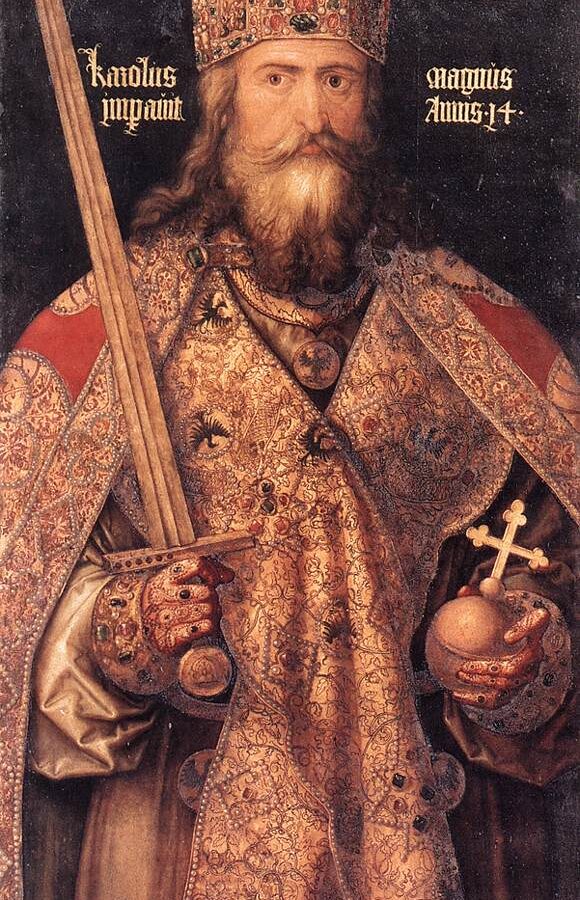
Later paintings do not solve the problem. Dürer’s famous portrait was created around 1511–1513, roughly seven centuries after Charlemagne died. It tells us how a later age imagined an emperor, not how he looked in a room.
What survives is enough for a careful conclusion, but not for an exact entry on a modern height chart.
Final answer: how tall was Charlemagne?
Charlemagne was probably around 1.84 metres tall, or about 6 feet. A defensible scientific range is approximately 1.79–1.92 metres (5 feet 10½ inches to 6 feet 3½ inches), based on different methods applied to a tibia attributed to him.
We should not call 1.84 metres an exact measurement, and Einhard’s “seven feet” does not mean seven modern feet. What can be said with confidence is simpler: both the near-contemporary written description and the skeletal estimate indicate that Charlemagne was unusually tall for his period.
That makes the evidence stronger than the estimates available for Alexander the Great or Julius Caesar, whose exact heights remain unknown.
Sources and further reading
- Einhard, Vita Karoli Magni, chapter 22 (Latin text).
- Frank J. Rühli et al., “Charlemagne was very tall, but not robust,” Economics & Human Biology 8.2 (2010), 289–290.
- Wikimedia Commons: Albrecht Dürer’s Emperor Charlemagne (public domain).
- Wikimedia Commons: throne of Charlemagne in Aachen Cathedral (CC0/public domain).
Frequently asked questions
Was Charlemagne really seven feet tall?
Probably not. Einhard wrote that Charlemagne’s height equalled seven of his own foot-lengths, not seven standardized modern feet. The phrase describes a bodily proportion and cannot be converted directly into 2.13 metres.
What is the best modern estimate of Charlemagne’s height?
The best-known modern estimate is about 1.84 metres, or roughly 6 feet. It was calculated from a 430-millimetre tibia attributed to Charlemagne.
Was Charlemagne tall for the Middle Ages?
Yes. The researchers placed the reconstructed height near the 99th percentile of their medieval comparison data. Their comparison average was approximately 1.69 metres, although medieval averages varied between populations.
Did Einhard know Charlemagne personally?
Einhard was a courtier in Charlemagne’s circle and had direct knowledge of the Carolingian court. That makes him a near-contemporary source, but his biography was also admiring and shaped by literary models.
Are Charlemagne’s surviving bones authentic?
The remains in Aachen are traditionally identified as Charlemagne’s, and scientific study has found them compatible with the historical individual. Absolute identification remains difficult because the remains have a long and complicated history.