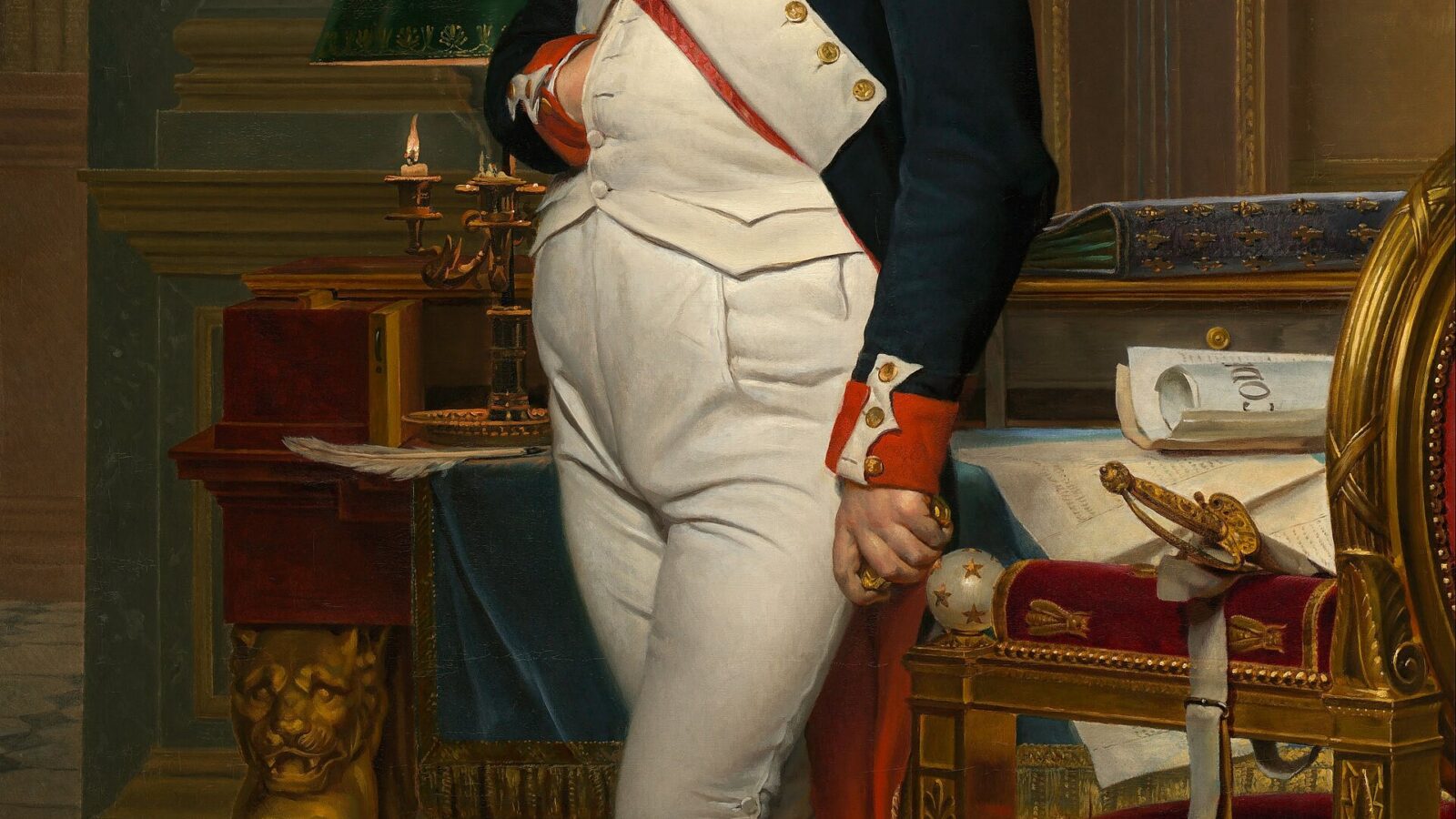
Napoleon Bonaparte was about 1.68–1.69 metres tall, with a pale complexion, grey-blue eyes, chestnut hair that thinned with age, and a compact build that became heavier in his later years. Contemporary portraits, eyewitness descriptions, clothing, and his death mask allow a more grounded reconstruction than we have for most ancient rulers.
Even so, no single image is neutral. Official painters made him heroic, British caricaturists made him tiny, and the familiar hand-in-waistcoat pose became a visual shorthand rather than a candid snapshot.
What did eyewitnesses say about Napoleon?
Accounts commonly describe a pale or sallow face, penetrating grey or blue-grey eyes, a straight nose, a firm mouth, and fine chestnut-brown hair. His head appeared large relative to his body. In youth he was notably thin; by the imperial period and especially on Saint Helena, he had gained weight.
Descriptions changed with circumstances. Soldiers remembered the energetic general in plain uniform, courtiers saw the emperor in formal dress, and hostile observers interpreted the same stillness or gaze as coldness. Physical description and character judgement often blended together.
How accurate are Napoleon’s official portraits?
Artists such as Jacques-Louis David and François Gérard created recognizable but strategic images. David’s Napoleon Crossing the Alps transforms a difficult journey largely made on a mule into a calm commander on a rearing horse. The face is idealized and the scene is propaganda.
David’s later portrait of Napoleon in his study is quieter. It shows thinning hair, a fuller face, tired eyes, and wrinkled stockings, while the clock and papers present an emperor working through the night. Its realism serves another political message: disciplined administrative labour.
What can the death mask tell us?
A plaster cast was taken shortly after Napoleon died on Saint Helena in 1821. Versions associated with Dr François Carlo Antommarchi preserve a broad forehead, closed eyes, straight nose, and small, relaxed mouth. Because death changes soft tissue and the casting history is disputed, a death mask is not identical to a living face.
It is still useful when compared with portraits and written descriptions. The mask supports the familiar general structure of Napoleon’s face without validating every heroic painting.
Was Napoleon short and stocky?
He was not unusually short for a French man of his generation. The post-mortem measurement of five French feet two inches converts to roughly 1.68–1.69 metres because the French foot was longer than the English unit. The myth grew through unit confusion, British caricature, and his nickname “the Little Corporal.”
His body also changed. The gaunt young artillery officer of the Italian campaign is not the same physical figure as the older exile. Our articles on Napoleon’s measured height and why Napoleon was considered short examine that myth in detail.
Why is his hand inside his coat?
The hand-in-waistcoat pose was a conventional gesture of composed respectability in eighteenth- and early nineteenth-century portraiture. It was not evidence that Napoleon had chronic stomach pain or a secret deformity. Other men were painted in the same pose before and during his lifetime.
Its later fame comes from association. Once Napoleon became the best-known sitter shown that way, viewers interpreted a standard portrait convention as a personal habit.
Final answer: what did Napoleon really look like?
Napoleon was an average-height man with pale skin, grey-blue eyes, a straight nose, a broad forehead, and fine chestnut hair. He was very thin as a young officer and heavier in middle age. His appearance could be intense in person, but his political image magnified that effect.
Official portraits, hostile caricatures, and the death mask should be read together. Each records part of the story, and each has limits.
Sources and further reading
Frequently asked questions
What colour were Napoleon’s eyes?
Eyewitnesses commonly described his eyes as grey or blue-grey.
Was Napoleon short?
No. At roughly 1.68–1.69 metres, he was around average height for a French man of his generation.
Is Napoleon’s death mask authentic?
A mask was cast after his death, but the history and attribution of surviving versions have been debated.
Why did Napoleon put his hand in his coat?
It was a conventional portrait pose associated with composed respectability, not proof of stomach pain.