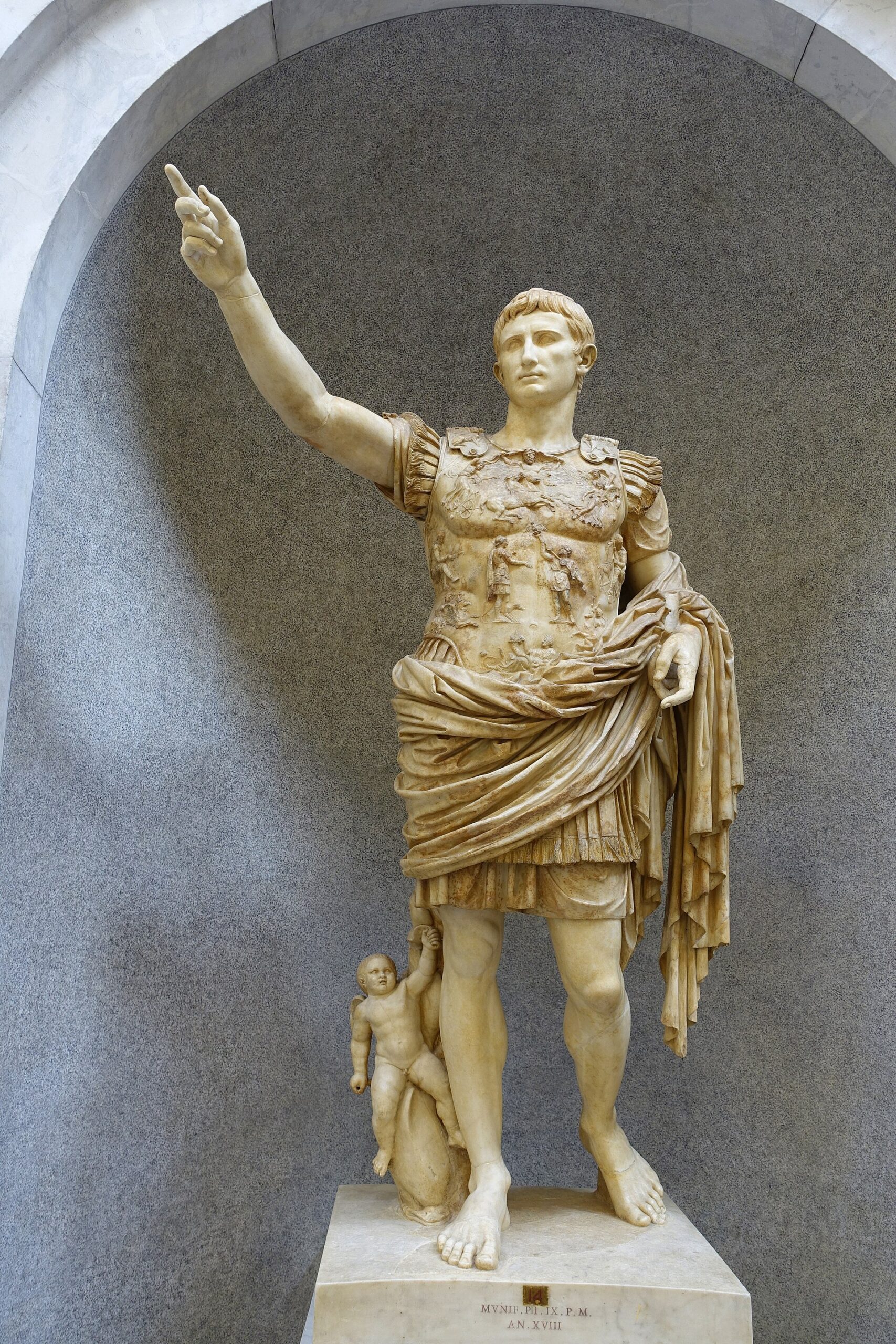
Augustus’s reported height was roughly 1.70 metres, or about 5 feet 7 inches in modern units. The figure comes from a measurement attributed to his freedman Julius Marathus and preserved by Suetonius. It is an ancient report, not a securely verified measurement of surviving remains.
A common trap is to read the translated figure of five feet nine inches as modern English feet and inches. The passage refers to Roman measure. The conversion, and the way the report reached us, are essential parts of the answer.
What is the ancient source?
In Life of Augustus, chapter 79, Suetonius describes Augustus as short, but adds the measurement attributed to Julius Marathus. Marathus was closer to Augustus than Suetonius, who wrote after the emperor’s lifetime.
This gives us a named source behind the number, which is more informative than an unattributed figure on a modern height chart. It still leaves an indirect chain of transmission. We cannot inspect the original measuring procedure or determine from this passage whether footwear, posture, or rounding affected it.
Why Roman feet are not English feet
The translation’s footnote explicitly identifies the figure as Roman measure and gives its English equivalent as a little under five feet seven inches. Expressed metrically, that is approximately 1.70 metres.
The calculation should remain approximate. Converting an old report with a modern calculator can produce several decimal places, but those decimals belong to the arithmetic, not to the historical evidence. “Roughly 1.70 metres according to a surviving report” communicates the useful information without claiming millimetre-level accuracy.
This is also why two websites can appear to disagree while relying on the same sentence: one may convert the original units; another may mistake the translation’s familiar words for modern measurements. Always follow a number back to its source before comparing it.
Does “short” contradict the reported measurement?
Not necessarily. Suetonius’s description is a relative judgement, not a statistical statement about a carefully defined population. He adds that Augustus’s proportions made his stature less obvious except beside a taller person.
To establish whether he was short for his time, we would need a relevant comparison group and a reliable individual measurement. Roman-period skeletal samples vary by region, date, and method, as explained in our guide to Ancient Roman height. There is no single empire-wide average that resolves every case.
Did he wear shoes to look taller?
Suetonius says in chapter 73 that Augustus wore somewhat high-soled shoes to increase his apparent height. That is a literary anecdote, not a surviving pair we can use to measure an exact lift.
It fits the author’s description of a man concerned with how he appeared in public. It does not tell us that every statue’s height included a hidden adjustment or that his reported stature should be reduced by some invented number of centimetres.
Can his statues settle the question?
No. A statue represents a person at the scale chosen by its maker and commissioner. Measuring a monumental figure cannot reveal its subject’s standing height unless there is independent evidence that the scale was strictly life-size and anatomically exact.
That distinction also applies to Julius Caesar’s height. Visual presence and physical stature are different questions.
The safest answer
Use roughly 1.70 metres as a conversion of the report preserved by Suetonius, with the source qualification attached. Do not present 5 feet 9 inches in modern units as the passage’s result, and do not treat a literary description of shortness as a population study.
Frequently asked questions
How tall was Augustus?
A measurement attributed to Julius Marathus and preserved by Suetonius converts to roughly 1.70 metres. It is a reported ancient figure, not a verified modern measurement.
Was Augustus 5 feet 9 inches tall?
Not in modern English units on the basis of this passage. The measurement is in Roman units, which were smaller.
Was Augustus considered short?
Suetonius describes him as short, but that judgement does not establish his percentile within a defined Roman population.
Discussion
1 comment
[…] A head cannot establish full-body height. That question has a separate literary measurement and a unit-conversion problem, examined in how tall Augustus was. […]