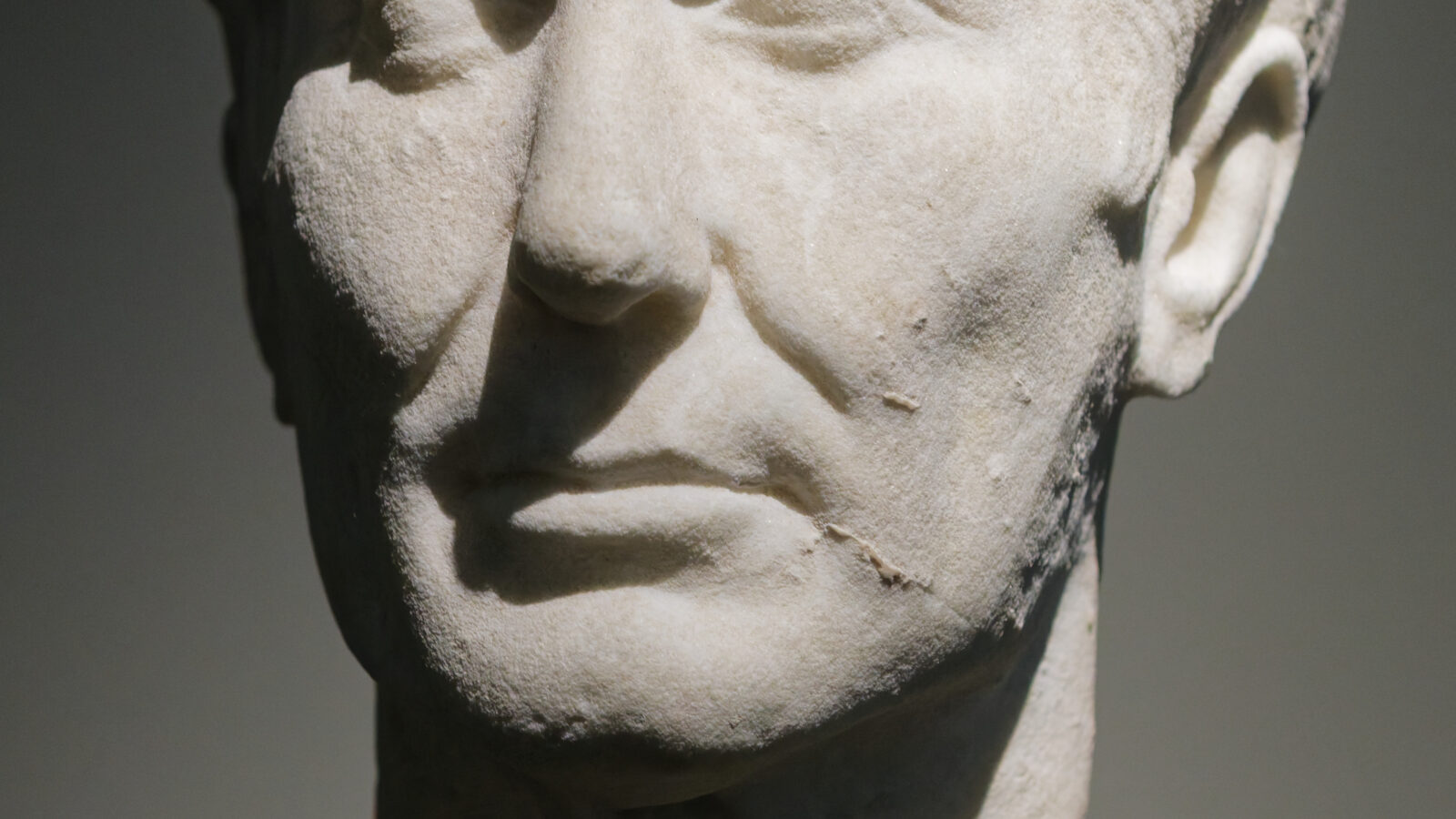
Julius Caesar probably had a lean face, a high or receding hairline, and a long, narrow head with prominent features. The closest evidence comes from coins struck during the final weeks of his life and from sculpted portraits that may preserve a contemporary likeness. None is a photograph, and not every bust labelled “Caesar” is authentic.
The familiar image of an older, thin-faced statesman is better supported than the smooth, heroic Caesar of later paintings. Yet even the best surviving portraits were political objects designed to communicate authority.
What did ancient writers say about Caesar’s appearance?
Suetonius, writing more than a century after Caesar’s death, described him as tall, fair-complexioned, well formed, and somewhat full-faced, with keen dark eyes. He also wrote that Caesar was troubled by baldness and carefully combed thinning hair forward from the crown.
The account in Life of Julius Caesar is detailed but not contemporary. Suetonius had access to earlier material that no longer survives, while also collecting anecdotes and character-revealing stories. His description should be compared with visual evidence rather than accepted word for word.
Why are Caesar’s coins so important?
In 44 BCE, Caesar became the first living Roman to appear repeatedly on Roman coins. These small profile portraits were produced under his authority and circulated while he was alive. They show a long neck, a receding hairline, a narrow or lined face, and a prominent nose and chin.
Coin portraits are not neutral snapshots. Different dies vary, the surface is tiny, and the image carried political messages. Even so, lifetime coins are anchored to Caesar’s own period and provide an essential check on later idealized sculpture.
Is the Tusculum bust really Julius Caesar?
The marble head found near Tusculum is widely identified as Caesar because its facial structure closely resembles his lifetime coin portraits. It shows an elongated skull, hollow cheeks, a thin mouth, wrinkles, and advanced hair loss. Scholars often date the type to Caesar’s lifetime or shortly after it.
Identification still involves comparison and interpretation. The head was not excavated with a name tag, and surviving versions can be later copies. “Probably Caesar” is stronger than saying that every detail records his face with perfect accuracy.
What about the famous Chiaramonti Caesar?
The Vatican’s Chiaramonti portrait presents a more regular and commanding face. It helped shape the modern textbook image of Caesar, but it is generally treated as a posthumous portrait type. It may preserve recognizable features while smoothing them into the dignified language of Roman state portraiture.
This distinction explains why two “authentic” Caesars can look different. Roman portraits were copied across media and generations. Artists could age, idealize, or regularize a ruler according to the purpose of the image.
Was Caesar embarrassed by baldness?
Suetonius says baldness caused Caesar particular distress and that he gladly accepted the right to wear a laurel wreath continuously. This anecdote fits the receding hairline on the coins and the Tusculum portrait, although its psychological detail cannot be independently verified.
Later art often gives Caesar a fuller fringe or places the wreath prominently over the crown. The laurel was first a symbol of triumph and honour; its usefulness as a covering may also have made it personally welcome.
Did Caesar have a deformed head?
Some reconstructions emphasize the unusual cranial shape of the Tusculum portrait, and modern discussions sometimes turn that feature into a medical diagnosis. A carved marble head is not sufficient for diagnosing birth trauma or a neurological condition. Style, copying, damage, and the original sculptor’s choices all affect its form.
It is safer to describe what the object shows than to infer a disease: an elongated, uneven head shape in a portrait type associated with Caesar.
Final answer: what did Julius Caesar really look like?
The best evidence suggests a mature man with a long, lean face, marked hair loss, a prominent nose and chin, thin lips, and intense eyes. His lifetime coin portraits and the Tusculum type are more useful than Renaissance paintings or modern actors.
We can recover a plausible portrait, not a perfect face. We know even less about Caesar’s exact height, because portraits of the head cannot establish total stature.
Sources and further reading
Frequently asked questions
Do we know what Julius Caesar looked like?
We have a plausible likeness from lifetime coins and portraits such as the Tusculum type, but no image is equivalent to a photograph.
Was Julius Caesar bald?
He had significant hair loss. Suetonius mentions it, and his lifetime coins and likely portraits show a receding hairline.
Is the Tusculum bust really Caesar?
It is widely identified as Caesar because it closely resembles his lifetime coin portraits, although identification is still an archaeological judgement.
What colour were Caesar’s eyes?
Suetonius described his eyes as dark and keen, but the account was written more than a century after Caesar’s death.